
Hendersonville TN Tree Removal provides tree disease treatment and plant health care across Hendersonville and the surrounding Sumner County area, backed by more than 20 years of watching how trees decline on this ground. The service is diagnostic first and horticultural second, because the most common reason a treatment fails here is that it was aimed at the wrong problem.
A declining tree in a residential yard is usually reporting a site condition rather than an infection. Construction fill over the root zone, a flare buried by years of mulch, compacted soil from equipment traffic, a grade change nobody thought about, or simply drought on a lot with shallow topsoil will all produce thin canopies and dying tips. None of those responds to a product.
So we look at the base, the soil and the history of the property before we look at the leaves. Where a genuine pest or pathogen is present we say so and treat it. Where it is not, we say that too, and the recommendation is often cheaper than the program somebody else quoted.
Diagnosis Before Treatment
What the Canopy Tells You, and What It Does Not
Thinning from the top down, dieback at the branch tips, small pale leaves and an early fall color change all mean the tree is under stress, and none of them names the cause. Canopy symptoms are lagging indicators — by the time they are obvious the underlying condition has been present for seasons. They tell us how far along the decline is, not what started it.
The Root Flare Is Where the Answer Usually Is
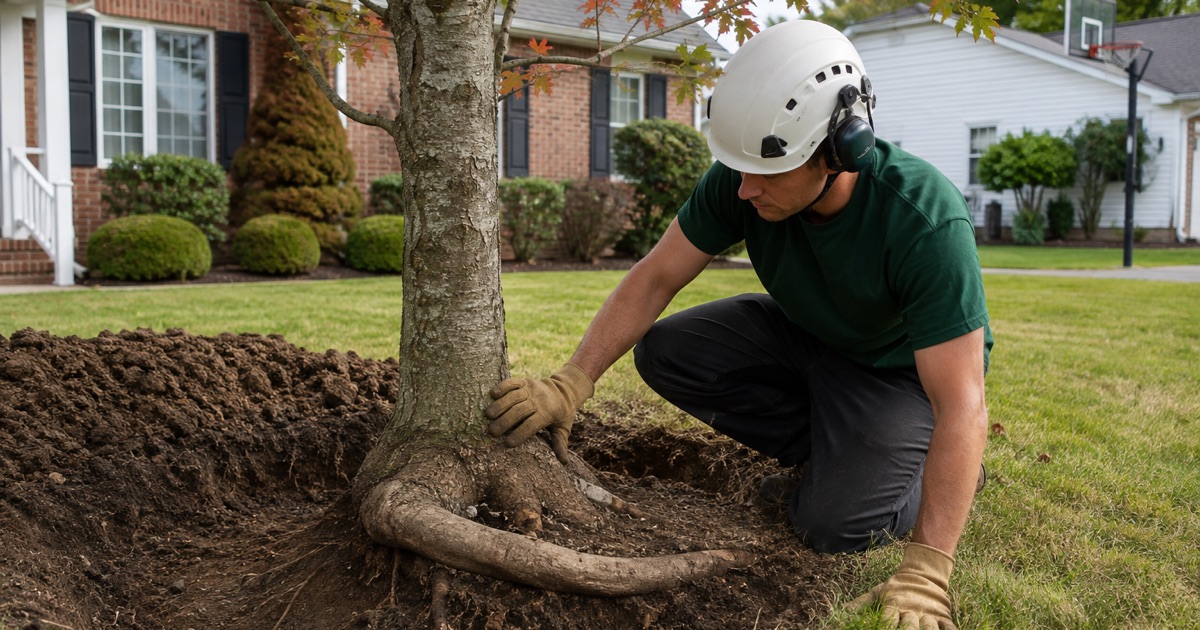
A trunk that enters the ground like a post instead of flaring outward is buried, girdled or both, and that single observation explains a large share of the declining trees we are called to. Excavating the flare with an air spade exposes the root architecture without severing the roots we came to evaluate, and it frequently ends the diagnosis in the first hour.
Site History: Construction, Fill and Grade Changes
We ask what has happened around the tree, because the answer is usually recent. A layer of fill spread over a root zone, a driveway widened through the dripline, a trench cut for a service line, or a season of equipment parked under the canopy will each kill fine roots that the tree then spends years failing to replace. The city’s own construction rules take this seriously enough to require dripline fencing.
Insects and Pests We Actually See Here
Emerald Ash Borer and the Ash That Is Already Gone
Tennessee’s Department of Agriculture repealed its emerald ash borer quarantine in 2021, but the insect stayed. The practical distinction for a homeowner is between an ash still carrying most of its canopy, which can be put on a preventive program, and one that is past that point, which is a removal with a clock on it — borer-killed ash loses limb wood strength quickly and becomes genuinely hazardous to climb.
Spotted Lanternfly Egg Masses
Egg masses are laid on bark and on almost any hard surface nearby, and they look enough like a smear of dried mud to be ignored. We check the trunks we cut and the material we haul, because moving infested wood is the fastest way to move the insect. If you find masses on your own trees, scraping them off in winter is genuinely useful work that costs nothing.
Secondary Pests on Trees That Were Already Stressed
A great many borer, scale and canker problems are opportunists that colonized a tree already weakened by something else. Treating them without addressing the underlying stress buys a season. That is why the diagnosis matters more than the product: a pest finding is often the second half of the story rather than the first.
Decay and Disease in the Trunk and Roots
Conks at the Root Flare and Decay in the Buttress
A fruiting body at the base is the outward sign of decay inside the structural roots. Because that is the wood holding the tree upright, the assessment is structural rather than medicinal: how far the decay extends, how much sound wood remains, and what sits within falling distance. Some of those findings end in monitoring, and some end in a removal recommendation the same week.
Cankers, Dieback and the Epicormic Response
A sudden flush of epicormic sprouts along a trunk or major limb is a stress signal, not a sign of vigor — the tree is activating dormant buds because it has lost canopy elsewhere. Combined with sunken bark, oozing or flagging branches, it points at a vascular or canker problem. We prune out what is prunable and set a review interval rather than promising a cure.
Conifer Screens That Are Failing From the Inside
Leyland cypress and similar screens planted too close together fail in a characteristic way: browning from the interior outward, then whole-plant collapse, accelerated by drought and root competition. Because these species cannot regenerate from cuts into old wood, no treatment restores the shape. The realistic choices are removing alternate plants to relieve the crowding, or replacing the row.
Soil, Root Zone and Honest Limits
Root Collar Excavation and Soil Decompaction
Air spading is the workhorse of plant health care here. It exposes buried flares, finds girdling roots that can then be cut deliberately rather than discovered by accident, and loosens compacted soil without shredding the fine roots that do the feeding. On the deep Harpeth and Mimosa soils mapped under most of this city there is real root volume to recover, which makes the work worth doing.
Mulch and Water: The Two Cheapest Interventions
A proper mulch ring — wide, thin, and pulled back off the trunk rather than piled against it — and deep, infrequent watering during dry spells outperform most purchased treatments on a stressed shade tree. Neither is billable in an interesting way, which is probably why they are recommended less often than they should be. We recommend them first anyway.
When Treatment Is Not Worth Buying
Some trees are past the point where money changes the outcome, and saying so is part of the service. A tree with extensive decay through the buttress roots, an ash with most of its canopy gone, or a poorly sited specimen that has been declining for a decade are all cases where a treatment program is spending against a result nobody will get. We will tell you which category yours is in.
- 20+ Years in Middle Tennessee
- Free Written Estimates
- Emergency Storm Response