
Hendersonville TN Tree Removal handles property line and neighbor tree work across Hendersonville and the surrounding Sumner County area, drawing on more than 20 years of standing between two households and one tree. It is the part of the trade where the technical question is usually simple and the answer nobody wants is “it depends whose ground the trunk is on.”
Almost every one of these situations improves the moment somebody writes something down. An opinion delivered over a fence is an opinion; a dated assessment naming the defect, the target and the likelihood of failure is a document a board, an insurer or an attorney can act on. Producing that is usually the most valuable hour we spend on the job.
We also decline work regularly here, and it is worth saying so plainly. We do not cut a tree without the permission of the person who owns the ground under its trunk, we do not exceed the property line because a customer would prefer we did, and we will tell you when the removal you want is not one you are entitled to.
What Tennessee Law Actually Says
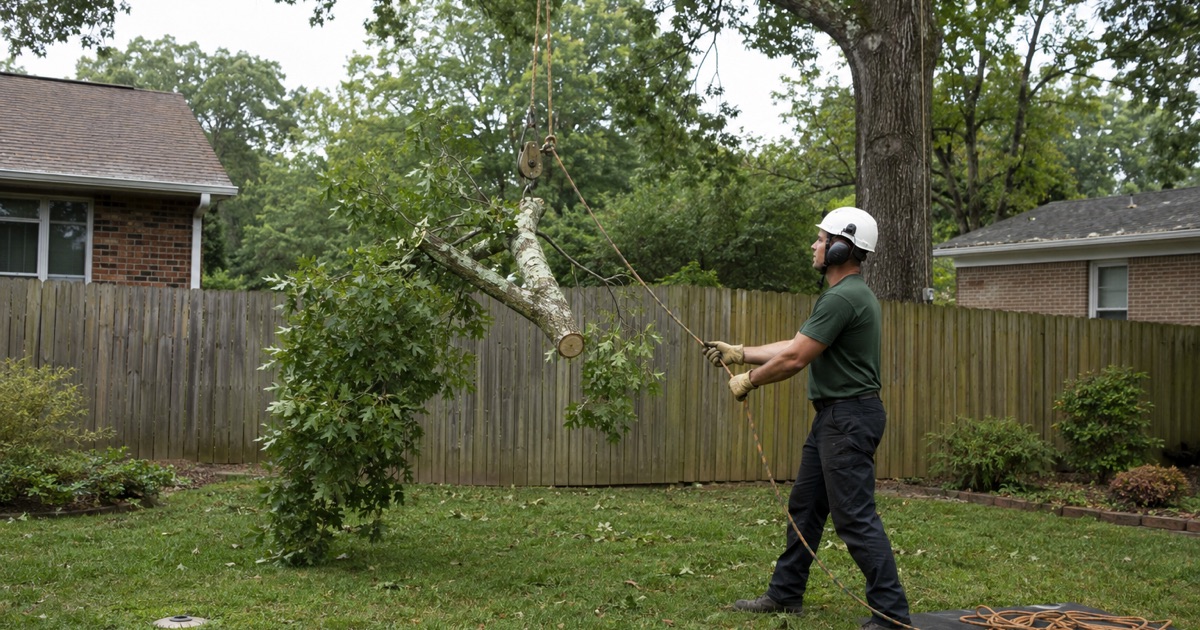
The Hawaii Rule, in Plain Terms
Tennessee adopted what courts call the Hawaii Rule in Lane v. W.J. Curry & Sons. The practical content is a right of self-help — an owner may cut encroaching branches and roots back to the boundary — combined with a further remedy where an encroaching tree is causing actual harm to the property rather than merely dropping leaves onto it — and both halves matter, because most disputes are really about the second one.
Self-Help Has a Boundary and a Bill
Two limits get overlooked. The first is spatial: you may cut to the line and no further, and that includes roots. The second is financial: trimming an encroachment is your cost, not your neighbor’s, however unwelcome the tree is. Doing the work so aggressively that the tree dies also exposes you, so this is exactly the case for a proper reduction cut rather than a fast one.
When an Encroaching Tree Becomes More Than a Nuisance
The threshold that matters is actual harm — roots lifting a slab, a limb bearing on a roof, a structurally defective stem within reach of a dwelling — rather than inconvenience. Shade, leaf litter, acorns and pollen are things trees do. Getting that distinction right before a letter goes out saves a great deal of money, and it is the first thing we assess when somebody calls about a neighbor.
Establishing Where the Tree Actually Stands
The Trunk Decides Ownership, Not the Canopy
Ownership follows the ground the trunk occupies, not the extent of the branches or the roots. A tree rooted three feet inside the neighbor’s line belongs entirely to them even if two thirds of its canopy is over your driveway. That single fact resolves a large share of the arguments we are called into, usually in a direction one party was not expecting.
Boundary Trees Standing On the Line
Where the trunk straddles the boundary the situation changes: the tree is generally the shared property of both owners and neither may remove it alone. Those trees need a conversation and an agreement before any crew is booked. They are also the ones most likely to have grown around an old fence, which makes the flare worth examining carefully before anyone asserts anything.
Survey Pins, Fences and Where People Are Wrong
Fences are not boundaries. Plenty of the fence lines in older Hendersonville subdivisions sit somewhere other than the platted line, and a tree planted along a fence forty years ago may be on either side of the real one. Where the answer is genuinely close, a surveyor settles it for less than one round of legal correspondence costs.
Documentation That Ends the Argument
The Written Hazard Assessment
This is the deliverable that does the work. A usable report identifies the tree by species and diameter at breast height, states the defect and how it was observed, names what sits within falling distance, and rates likelihood and consequence over a stated period. That structure is what an insurer engages with, and it is what the city’s own ordinance has in mind where it accepts written verification from a qualified specialist.
Photographs, Dates and the Certified Letter
Sequence matters more than volume. Photographs taken before the letter, an assessment dated before the failure, and delivery that can be evidenced later are what establish notice. A neighbor who has been given a written finding and taken no action is in a materially different position from one who genuinely did not know, and that difference is the whole of many claims.
What an Adjuster Actually Does With It
Adjusters work from documents. A pre-failure assessment tells them the condition was known; post-failure photographs of the fracture surface and the root plate tell them whether the tree was decayed or simply overloaded by an event. We produce both, and we keep the debris line separate on the invoice because debris removal is usually capped separately from the repair.
Doing the Work Without Starting a Feud
Cutting to the Line Without Killing the Tree
Trimming to a boundary is still pruning, and it should be specified as reduction cuts back to laterals rather than a flat vertical shear along an imaginary plane. A tree sheared down one side loses a large share of its canopy on that face, responds with weak sprouts, and looks like exactly what it was. Doing it properly protects you as well as the tree.
Access From the Other Side
Many of these jobs are far easier and much cheaper if the crew can work from the neighbor’s yard for an afternoon. That is a request rather than a right, and it is worth making politely and early. Where it is refused, the work usually still gets done — it simply takes longer, sometimes needs a lift, and costs more, which is worth knowing before the estimate lands.
After a Failure: Whose Claim Is It
When a tree has already come down across a line, the first jobs are documentation and making the scene safe, in that order, and the ownership argument comes afterward. We clear what is dangerous, photograph what matters, and keep the invoice structured so that each party’s carrier can see what was done on whose property. Sorting the liability question is not a reason to leave a stem hanging over a driveway.
- 20+ Years in Middle Tennessee
- Free Written Estimates
- Emergency Storm Response