
Hendersonville TN Tree Removal handles emergency tree removal in Hendersonville, TN, serving surrounding cities including Mount Juliet, Oak Hill, La Vergne, Forest Hills and Brentwood. Twenty years of storm response in Middle Tennessee is mostly twenty years of judgment about sequence: what has to be cut in the next hour, what is safe to leave until morning, and what nobody should be near at all.
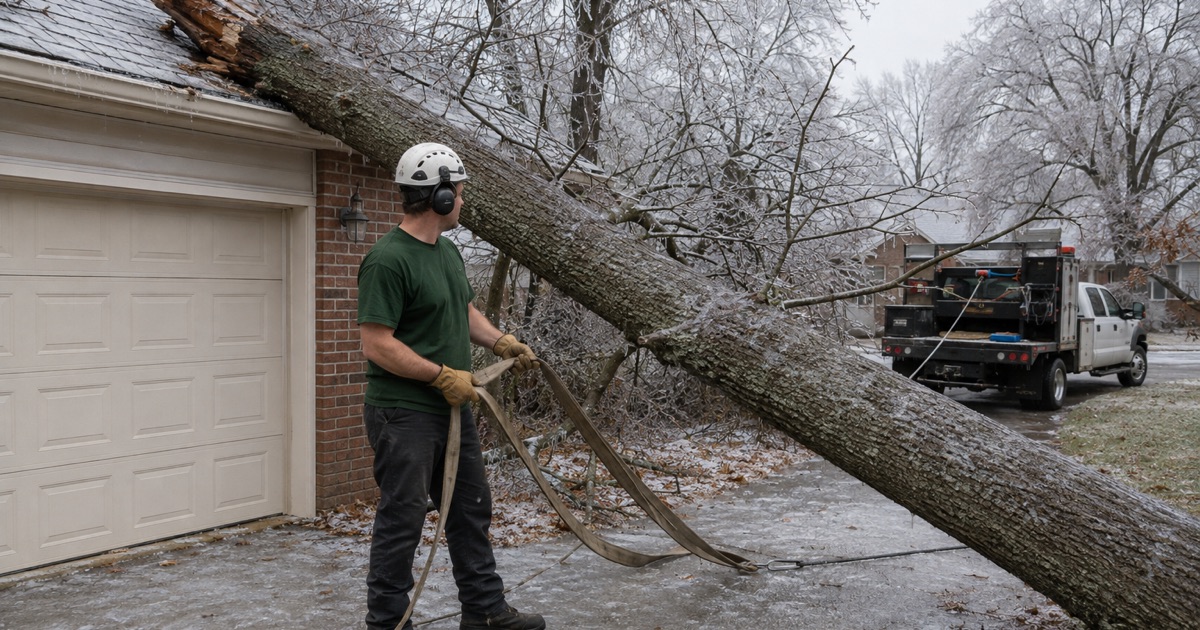
Storm work is dangerous in a way routine removal is not, because every piece is already under load that somebody else applied. A limb bent into a spring pole, a stem hung in a neighboring canopy, a half-fallen trunk resting on a rafter — each of those has stored energy and a release direction, and cutting them in the wrong order is how people get hurt. We read the loading before the saw starts.
And we call the electric utility first whenever a conductor is anywhere in the picture. Two providers serve this city under different rules, the city owns neither, and no amount of experience makes an energized line safe to work around. That call is not a formality, it is the first step of the job.
The Storms That Actually Bring Trees Down Here
The December 9, 2023 Tornado
The National Weather Service in Nashville surveyed the Madison, Hendersonville and Gallatin tornado as an EF-2 with estimated peak winds of 130 mph, a path 35.23 miles long and up to 600 yards wide, on the ground from 4:39 p.m. to 5:31 p.m. Its damage narrative is almost entirely tree language — trees uprooted, trees snapped, hundreds blown down — which is a fair description of what the calls looked like afterward.
Winter Storm Fern and the January 2026 Ice
The January 2026 ice storm was the slower and in some ways larger event. Thousands of Sumner County customers lost power, and the mayor’s warning during recovery was that trees were still falling — many of the remaining outages were single-tree or single-pole failures serving only a handful of homes. Ice keeps loading long after the precipitation stops, and it keeps failing limbs during the thaw.
Why Framing This as Summer Storm Season Misses It
The two events that generated the tree work in this city were a December tornado and a January ice storm. Neither is a summer convective thunderstorm, and a homeowner planning around July wind is preparing for the wrong month. Pre-season pruning of weak unions and deadwood here is autumn work, done before the first ice, not spring work done after the last frost.
What Happens in the First Hour
Triage: What Is Still Carrying Load
The first decision is which parts of the scene are still storing energy. A trunk resting on a ridge beam is holding a roof partly up and cutting it wrong drops the rest, a branch bent under a fallen stem is a spring pole, and a crown hung in the neighbor’s tree can come down in any direction. We identify each of those before touching any of them.
The Electric Utility Comes Before the Saw
Cumberland Electric requires a service order to drop a secondary before anyone touches it, and does not clean up storm-downed trees. Nashville Electric Service does not remove trees near service lines but will disconnect service free of charge. Knowing which provider serves the address decides who we call and how long the wait is, and it is the single most useful thing a homeowner can find out while waiting for us.
Making a Scene Safe Without Making It Worse
Sometimes the right immediate action is small: tape off a drop zone, cut a path to a door, take one limb that is loading a gutter, tarp an opening before the next band of rain. Doing only that and returning in daylight is frequently better than a full dismantle by flashlight, and we would rather explain why than demonstrate it the hard way.
The Hard Cases
Trees Down On a Roof, or Through It
A stem across a structure is unloaded in pieces from the far end inward, with each cut sized so the remaining weight does not shift onto the damaged framing. Rigging through a block onto a lowering device controls the descent; a crane does it faster where one can be set. What we avoid is the single confident cut that transfers the whole green log weight onto rafters that were never designed for it.
Hung-Up Stems and Spring Poles Under Tension
A tree that fell into another tree is the most under-rated hazard on any storm site, because it looks stable and is not. The same goes for saplings and limbs bent double under a fallen trunk. Both are released deliberately, from outside the arc, with the crew positioned for where the piece will actually go rather than where it appears to be pointing.
Uprooted Root Plates and the Crater Behind Them
The deep, well-drained Harpeth and Mimosa soils mapped across this city let a root plate develop broadly rather than forcing it into a shallow pan, so an uprooted tree here tends to bring up a large disc of soil that then stands on edge. That plate can rotate back into the hole once the trunk is cut, which is why the trunk is severed with the plate secured, and why the crater gets filled rather than left as a hazard.
Insurance, Documentation and the Order of Work
Photograph Before Anything Moves
The wide shot is the one people forget. Photographs that establish which tree, which direction it came from, what it struck and what condition the fracture surface was in are worth more to an adjuster than close-ups of splintered wood. We take our own set as well, because the crew sees the failure surface as the tree comes apart and that view disappears once it is chipped.
Tarping, and What a Carrier Calls Neglect
Most policies expect a homeowner to prevent further damage once a loss has occurred. An unsealed opening that lets three more days of rain into a ceiling turns one claim into an argument, so tarping is part of the emergency response rather than a separate service. Getting a cover on the roof also buys the time to schedule the removal properly instead of rushing it.
Debris Sublimits, and Why It Is Its Own Line
Debris removal is usually capped separately from the structural repair, so it helps for it to appear as its own line rather than buried in a total. Our storm invoices separate the removal of what struck the structure from the disposal of the material, which makes it straightforward to submit and straightforward to argue about if the carrier’s sublimit falls short.
After the Event
Storm Debris and Who Actually Collects It
After a large event the municipal system is overwhelmed on its own terms. Following the January 2026 storm, city and contracted crews collected roughly 100,000 cubic yards of vegetation by mid-March, contracted claw trucks could not safely operate on some streets, and mixed piles could not be collected at all because the limbs are ground into mulch. Anything a tree service cuts was never eligible in the first place.
The Damage You Cannot See From the Ground
The most dangerous wood after a storm is what stayed in the canopy: broken tops, detached limbs lodged in crotches, and cracked unions that have not let go yet. None of it is visible from the driveway. A post-storm inspection of the trees that stayed up is usually a short visit and it is the one that prevents the second incident a month later.
Emergency Pricing, Explained Rather Than Assumed
We would rather tell you the tree can wait than charge an emergency rate for work that is not one. Where the response genuinely has to be immediate, the estimate says what the after-hours component is and what the equipment mobilization costs, so the number is legible. Storm season is exactly when opaque pricing does the most damage to a homeowner’s trust, and it is not how we work.
- 20+ Years in Middle Tennessee
- Free Written Estimates
- Emergency Storm Response