
Hendersonville TN Tree Removal grinds and removes stumps throughout Hendersonville, TN, serving surrounding cities including Mount Juliet, Oak Hill, La Vergne, Forest Hills and Brentwood. Twenty years of running grinders on Central Basin ground is what lets us quote a depth with confidence instead of hedging, and it is why our estimates name the depth at all.
A stump quote has three numbers in it and most quotes show one. Diameter across the cut face sets the volume of wood, depth below grade sets how much of the root crown comes out, and access decides which machine can physically reach the work. A price with none of those attached is not comparable to a price that has all three, which is how two bids for the same stump end up hundreds of dollars apart.
The fourth thing people forget is what is left afterward. Grindings, the hole under them, and any wood that has to leave the property are real cost, and a stump that generated a mound of chips nobody agreed to move is a complaint waiting to happen. We settle all of it before the machine comes off the trailer.
How a Stump Is Measured and Quoted
Diameter Across the Cut Face, Not the Trunk
Stumps are measured across the top of the cut, at the widest point, including the flare — which is often considerably wider than the diameter at breast height anyone recorded for the standing tree. That flare is the densest wood in the stump and it is where a grinder spends most of its time. Quoting off a photograph of the trunk understates the job, so we measure on site.
How Far Below Grade the Grindings Go
Depth is a decision about what happens next, not a fixed setting. Turf needs only a few inches; a bed or a re-sod wants six to ten so nothing telegraphs through; a patio, a footing, a fence line or a replant wants more, and sometimes a wider excavation as well. We write the number on the estimate so there is no argument later about what “ground out” was supposed to mean.
Gate Width, Slope and the Narrow-Access Machine
A full-size grinder is fast and it does not fit through most side gates. A narrow-access stump grinder does, at the cost of time, and on a wet or sloped lawn it may need property protection mats to get there without leaving ruts. We measure the gate, the turns and the grade at the estimate, because discovering the constraint on the morning of the job is how the price changes.
What the Ground Under This City Does to a Grind
Harpeth and Mimosa Soils Give a Grinder Room
The Sumner County soil survey maps the built-up part of the city as the Harpeth-Urban land complex, and the Harpeth series carries more than 60 inches of solum before limestone, with Mimosa running 40 to 60 inches to rock. In practice that means a cutting wheel at six to twelve inches below grade is working in soil, which is why deep grinds here are usually a question of time rather than of feasibility.
Where Limestone Comes Up, and Why We Still Probe
Shallow rock exists in this county — the survey puts Barfield, at about 18 inches to bedrock, and Rock outcrop in the southeastern Central Basin — and no soil map resolves to a single back yard. A grinder that meets limestone stops making progress and starts making sparks and worn teeth. Probing before we commit to a depth costs a few minutes and keeps a quoted number honest.
Marking Utilities, Irrigation and Invisible Fence
A stump sits at the intersection of everything buried. Water service, gas, irrigation laterals, low-voltage lighting and pet fence wire all tend to run near the tree that was planted along the same line, and a grinder finds them instantly. Locates go in before the machine arrives, and the homeowner’s own knowledge of where the sprinkler line runs is genuinely more useful than any map.
Grinding, Excavation and the Options Between Them
Grinding a Stump Against Pulling the Root Ball
Grinding chews the stump and major surface roots into chips and leaves the remainder to rot in place, disturbing very little around it. Excavation drags the whole root plate out and leaves a crater plus a pile of soil-covered roots that then has to be disposed of by weight. For almost every residential stump grinding is faster, cheaper and far kinder to the surrounding lawn.
Surface Roots Lifting a Driveway, Walk or Patio
Where a root has raised concrete, the stump is only half the problem. If the tree is coming out anyway, the lifting roots can be ground with it and the slab repaired. If the tree is staying, cutting a structural root to save a walk can compromise the whole side of the root plate, so that decision gets made against an assessment rather than against a trip hazard.
Grinding for Turf Against Grinding for a Replant
A turf grind is shallow, fast and backfilled with the grindings themselves. A replant grind is deeper and wider, and the grindings come out entirely, because a new root ball set into wood chips sits in material that ties up nitrogen and settles for years. Telling us which one you want at the estimate is the difference between one visit and two.
Grindings, Backfill and Where the Waste Goes
The Volume of Chips Nobody Expects
A ground stump produces more material than the stump appeared to contain, because the wood comes out aerated rather than solid. A 30-inch stump can leave a mound over a foot high. That pile is not a problem if somebody decided in advance what happens to it, and it is an unpleasant surprise if nobody did, so it is a line on our estimates rather than a conversation at the end.
Backfilling, Topsoil and Getting Grass Back
Where the grindings leave, the void gets backfilled with topsoil and tamped, then raked flat and seeded if you want it. Where they stay, we mound slightly proud of grade because the material settles as it decomposes, and a hole left flush on day one becomes a depression by the following spring. Either way we rake the surrounding lawn clear of chips before leaving.
Why a Stump Cannot Go Out With the Brush
The city’s limb and brush collection is for material residents cut themselves, excludes vines and root balls in terms, and states that no commercial tree-cutting will be collected at all. Disposal is therefore a weighed transaction: the Sumner County Resource Authority takes brush and wood at $45 per ton with a $10 minimum, while stumps and root balls are classed as heavy construction on Gallatin’s schedule at $58 per ton.
Our Step-by-Step Stump Grinding Process
1. Measure, Mark and Agree the Depth
We measure the face, confirm the access route, mark utilities and irrigation, and write down the depth below grade and what happens to the grindings. Nothing about that step is ceremonial — it is where the price is actually set, and it is what the crew works from on the day.
2. Clear the Face and Protect What Stays
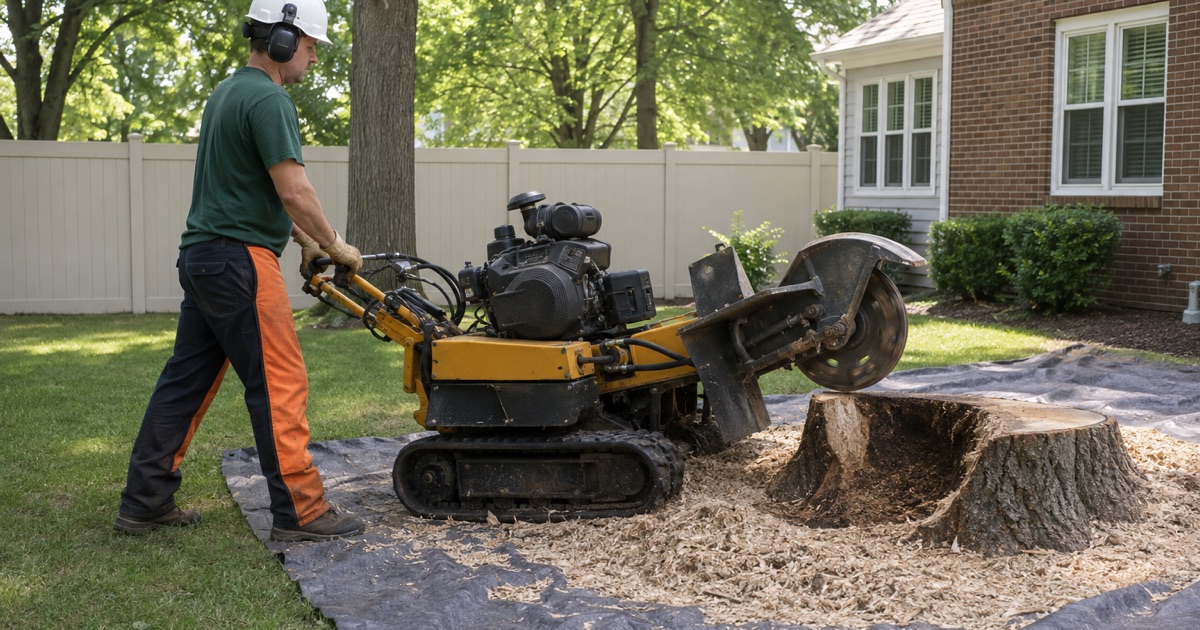
Dirt and gravel in the cut face destroy carbide teeth, so the stump gets cleaned off first. Plywood, mats or screens go up where chips could reach siding, windows, a pool or a neighbor’s car, and anything movable comes out of the throw zone before the wheel turns.
3. Grind to the Agreed Depth, Then Chase the Roots
The wheel takes the stump down in passes rather than one plunge, and once the main body is gone we follow the major surface roots out from the crown until they drop below grade. That second half is what stops a ridge appearing across the lawn a year later as the shallow roots decay and the soil settles over them.
4. Backfill, Rake and Haul
Grindings either go back in the hole and get mounded, or they get loaded out and the void is filled with topsoil. The lawn gets raked, the chips get blown off the drive and the walks, and anything leaving the property goes to a permitted site. Then you get told exactly what was done and to what depth, in writing, alongside the invoice.
- 20+ Years in Middle Tennessee
- Free Written Estimates
- Emergency Storm Response