
Hendersonville TN Tree Removal runs crane-assisted tree removals throughout Hendersonville and the surrounding Sumner County area, with more than 20 years of taking mature canopy off tight residential lots in Middle Tennessee. A crane is not a luxury upgrade on those jobs — it is frequently the only method that gets a large tree out of a back yard without something being damaged.
The decision to use one is made on the site visit and it turns on three questions: what the tree weighs, where the machine can sit, and whether anything can safely be dropped at all. Answer those and the method chooses itself. Skip them and you get the classic failure, which is a climbing crew committed to rigging a tree that never had the room for it.
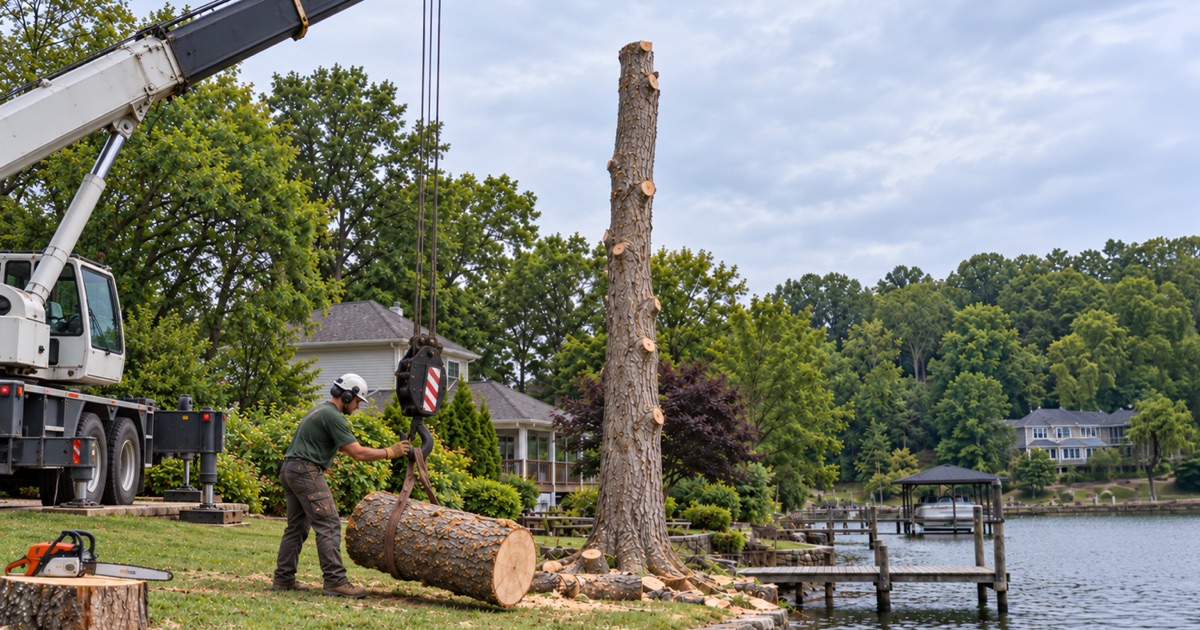
What a crane buys is control. Each section is picked before it is cut, held while it is severed, and flown out to a landing zone rather than falling anywhere. On a tree over a roof, over a pool, or over a neighbor’s fence, that difference is the entire job.
When a Crane Is the Right Machine
Trees With No Lay and No Room to Rig
A tall stem in a small yard surrounded by structures has nowhere to fall and often nowhere to lower pieces to either. Rigging works by lowering wood through the canopy to a spot on the ground, and where that spot is a sunroom or a pool deck the method runs out. A crane replaces the landing zone entirely, flying each piece over the obstruction to open ground.
Dead and Brittle Trees Nobody Should Be Climbing
The strongest argument for a crane is a tree that will not hold a climber. Ash killed by emerald ash borer loses limb wood strength quickly and becomes unpredictable to work; the same goes for storm-damaged stems with cracked unions and for anything with decay through the trunk. Picking those apart from outside, with the crew’s weight never on the tree, is the difference between a job and an incident.
Confined Back Yards With Zero Drop Zone
On a lot where the tree stands between a house, a fence and a shed, the useful measurement is not the height of the tree but the size of the largest clear space around it. Where that space will not accept a six-foot section of trunk, a crane and a landing area out front is a far quicker answer than carrying a mature tree out in pieces small enough for two people to lift.
What a Crane Pick Actually Involves
Weight Comes Before Everything Else
Green log weight is the number the whole plan is built on, and it is routinely underestimated because it scales with volume rather than with height. Each pick is sized so that the weight, plus the rigging, sits well inside the crane’s rated capacity at the radius that pick happens at. That is arithmetic done in advance, not judgment made with a section already cut.
Setup: Outriggers, Pads and Ground That Will Bear It
A crane transfers its whole load into four small footprints, so what is under them matters more than what is under the tires. Pads are sized to the bearing capacity of the ground, and anything hollow near the setup position — a septic tank, a cistern, an old cellar, a culvert — is located first. The deep, well-drained soils mapped across most of this city help, but no map substitutes for looking.
The Reach Problem, Not the Lift Problem
Cranes are rated by capacity at radius, and capacity falls sharply as the boom goes out. A machine that can lift a great deal at short reach may be able to lift very little over the back of a house, which is exactly where the picks are. Choosing the machine is therefore a question about geometry — where it can sit versus where the wood is — rather than about raw tonnage.
Access on Local Streets and Lots
Where the Machine Can Legally Sit
Most residential picks are made from the street or the driveway. That means thinking about lane width, whether traffic control is needed, parked cars, mailboxes, and whether a shared drive will take the axle loads. We drive the approach before the day rather than discovering a weight-limited culvert with the crane already committed to a narrow road.
Overhead Lines Across the Swing Path
The boom and the load both have to travel somewhere, and around here the answer usually involves a service drop. Two utilities serve this city — Nashville Electric Service and Cumberland Electric — under different rules, and the city owns neither, so we identify the provider and arrange a disconnect or a drop where the swing path requires it. Nothing swings over a live conductor.
Protecting the Ground the Machine Crosses
Where the crane, the chip truck or the loader has to cross a lawn, property protection mats go down first. It is slower and it is far cheaper than re-grading and re-seeding a rutted yard in July. On a wet week we will propose a date change rather than pretend mats solve saturated ground, because they do not.
Cost, Alternatives and Scoping It Honestly
Why the Crane Day Is Often the Cheaper Column
Compare total cost rather than day rate. A crane crew can dismantle and load a large tree in a single visit, with the wood leaving on the truck as it comes down. A climbing crew on the same tree may need multiple days, a larger ground crew, and a lawn full of material to carry out afterward. We price both where both are viable and show you the comparison.
The Alternatives, and When They Win
A tracked spider lift reaches into canopies a bucket cannot and crosses turf on mats, which suits pruning and mid-size removals. A grapple saw truck handles storm-damaged and hazardous stems from the street without anybody in the tree. Conventional rigging remains the right answer on plenty of jobs. The crane earns its place on weight, on reach, or on a tree that cannot be climbed.
What We Need in Order to Quote It
A useful crane quote needs the tree’s approximate height and trunk diameter, what stands under and around it, where a machine could set up, the width and surface of the approach, and where the wood can be landed and loaded. We collect all of that on the site visit and write the plan down, because a crane job improvised on the morning is a crane job that goes wrong.
- 20+ Years in Middle Tennessee
- Free Written Estimates
- Emergency Storm Response